Mobile Solitaire History: From JAMDAT to The Original Solitaire+
Long before the iPhone, people were playing solitaire on phones with tiny screens, physical keypads and very little memory. Making a good game for those devices required ingenuity: cards had to remain readable, moves had to feel natural, and an entire solitaire collection sometimes had to fit on a remarkably limited handset.
That era produced innovations players now take for granted, from clearer cards and smarter controls to downloadable designs, shared hands and daily challenges.
Solitaire Deluxe® helped pioneer those ideas. Today, its co-founder’s innovations continue at Official Game AI with The Original Solitaire+ and a new feature, Peek, that answers a familiar question: where was the card that could have saved that hand?
Before the App Store: solitaire reaches everyday phones
Solitaire was available on Palm devices and other handheld computers before it became a staple of ordinary mobile phones. JAMDAT Solitaire brought it to a much broader audience, becoming the first widely distributed feature-phone solitaire in the United States and reaching players in many other markets.
This was the early 2000s, when a few well-designed games were demonstrating just how much entertainment could fit into a phone.
JAMDAT Bowling was one of them. Its single-tap simplicity helped it become the most popular mobile game of its time, reaching millions of players and appearing preloaded on countless devices.
Our founder, Josh Hartwell, worked with JAMDAT on Bowling and FIFA Soccer in 2001 and 2002, developing an understanding of what made games work on the phones people already carried.
That experience led to GOSUB 60.
August 2003: Solitaire Deluxe launches
Hartwell founded GOSUB 60 with his wife and his programming partner. The company, later known as Mobile Deluxe, launched Solitaire Deluxe in August 2003.
It was the first mobile solitaire suite to bring together Klondike, FreeCell and Tri-Peaks.
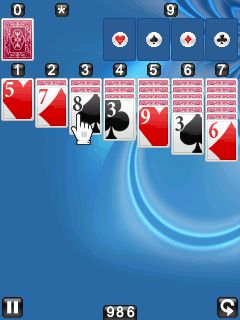
The game adapted to the capabilities of each phone. More capable devices received the suite; some smaller black-and-white Nokia handsets received a single Klondike game. The aim was to deliver an enjoyable solitaire experience across the range of phones people actually owned.
Solitaire Deluxe became a major competitor to JAMDAT Solitaire, rivaling its popularity and surpassing it on some carriers.
Innovations built around the player
On early phones, readability was a fundamental challenge. Screens were tiny, and some could display only black or white, without even shades of gray. A card’s value and suit had to be recognizable within those constraints.
Solitaire Deluxe introduced Easy-Read cards to make the game more comfortable to see and play. Across later editions, Intelli-Tap brought smarter card movement, reducing the effort needed to put cards where they belonged.
In the years following its 2003 launch, Solitaire Deluxe introduced further innovations:
- Direct phone-to-phone sharing of a hand. Through Text-a-Friend®, players could send a deal to a friend and play the same cards, bringing a shared experience to a traditionally solitary game.
- Downloadable content matched to the phone. Solitaire Deluxe was the first mobile game to offer downloadable content based on device type, allowing content to suit the handset receiving it.
- A content store inside solitaire. It was the first solitaire game to incorporate an in-game content store, giving players a way to expand and personalize their experience.
- Daily Deals. Solitaire Deluxe introduced daily solitaire deals, establishing a format that became familiar throughout the category as Daily Challenges.
The company invested in protecting these inventions and brands. Text-a-Friend was a registered trademark, and GOSUB 60 filed patent applications for its game-sharing technology in 2006 and its downloadable-content technology in 2007. Those applications became issued patents.
Each development served a practical purpose. Players could see their cards more clearly, make moves more easily, choose how their game looked, share a challenge with a friend and look forward to something fresh tomorrow.
Teaching mattered, too. As the collection expanded, its tutorials helped players discover variations they might otherwise have passed over. An early Pocket Gamer review of Solitaire Deluxe: 16 Pack singled out that strength with a simple observation: “It actually teaches you how to play.”
The iPhone opens a new chapter
The App Store’s arrival in July 2008 brought a new way to discover and download phone games. MobilityWare’s Solitaire was among its launch titles and became an important part of the iPhone’s solitaire history.
By then, Solitaire Deluxe had almost five years of mobile development behind it. Its move to the iPhone carried forward the experience gained from supporting different handsets, refining controls and helping players enjoy a growing collection of games.
Mobile Deluxe’s business relationships evolved alongside the devices. A sales team experienced in working with mobile carriers increasingly worked with platform partners, including Apple.
That relationship, together with the quality and presentation of Solitaire Deluxe, led to an unusual invitation.
Inside Apple’s secret iPad development program
Before the iPad launched, Apple confidentially invited Mobile Deluxe to send two people to Cupertino to adapt Solitaire Deluxe for the new device.
They worked in an interior, windowless room, making the game run and look right on hardware the public had not yet seen. The assignment was so closely guarded that they could not tell other people at Mobile Deluxe what they were working on.
Solitaire Deluxe was already an iPhone game. This was an opportunity to help establish what a polished solitaire experience could be on Apple’s new tablet, in time for its 2010 launch.
The journey from small monochrome phones to the iPad involved enormous changes in hardware. Readability, thoughtful controls and attention to presentation remained central throughout.
Daily play becomes part of mobile solitaire
As iPhone and Android gaming expanded, solitaire grew into a category built around much more than an individual deal. Collections, customization, daily challenges and achievements gave players additional reasons to return.
Microsoft brought Solitaire Collection to iOS and Android in 2016, including five solitaire variations, daily challenges, achievements and progress shared across devices.
Features that had once required new thinking about what a phone game could do were becoming part of players’ everyday expectations. Mobile Deluxe continued developing Solitaire Deluxe and its technology until the company was acquired by Murka in 2021.
Hartwell’s innovations in solitaire continued at a new studio: Official Game AI.
The Original Solitaire+: the next innovation is Peek
The connection between Solitaire Deluxe and The Original Solitaire+ runs through more than two decades of inventing useful features for solitaire players.
At Mobile Deluxe, that meant making cards easier to read, moves easier to make, hands possible to share and daily play something to anticipate. At Official Game AI, it means continuing to look closely at the experience of playing—and finding something worth improving.
Peek is the latest result.
With a physical deck, a hand that runs out of moves often ends with one last look under the piles. There was the ace. There was the ten that would have opened the game. Even a loss can leave a player with the satisfaction of understanding what happened.
The Original Solitaire+ brings that moment to the screen.
Press and hold Peek to reveal the face-down cards beneath the tableau, including after the hand ends. Players can finally find the card they were wondering about and see what was hidden from them.
It is a new interaction built around a very old solitaire habit.
That same attention extends to true random shuffles. Alongside winnable deals and Daily Challenges, The Original Solitaire+ gives players the experience of a genuinely shuffled deck—and celebrates their random-deal wins with dedicated leaderboards and achievements.
Smarter hints and unlimited Undo give players room to learn and reconsider. Using either feature never triggers an ad.
From Easy-Read cards and Text-a-Friend to Daily Deals and Peek, the ambition continues: invent features that make solitaire better for the people playing it.
Players have always come first
The goal from the beginning has been to create the best solitaire experience for everyone.
Customer care has always been a top focus because listening to players is essential to that goal. Their questions reveal where an explanation could be clearer. Their feedback reveals what could feel better. Their ideas open possibilities for the next useful feature.
That attention to players helped shape Solitaire Deluxe’s innovations, and it continues to shape The Original Solitaire+.
At Official Game AI, we welcome questions, feedback, ideas and suggestions. We want to know what players love, what frustrates them and what they wish their solitaire game could do. When something goes wrong, we want to fix it. When something could be better, we want to hear about it.
It is also why we make how-to videos and keep refining the game’s controls, hints and features. Every improvement serves the same ambition: make The Original Solitaire+ the best solitaire experience for every person who plays it.
Discover The Original Solitaire+
Experience the next chapter in a mobile solitaire history that began before the App Store.
Find the missing card with Peek. Enjoy a true shuffle and earn recognition for your wins. Discover smarter hints, thoughtful controls and a game shaped by decades of listening to solitaire players.
The full game is free to download and play on iPhone and iPad. No credit card. No subscription.
The Android app isn’t available yet. You can explore the features and Peek demo here, or play on a desktop computer.
For more about the studio behind the game, visit Official Game AI.
Sources and records
- Qualcomm’s March 2002 BREW announcement, listing JAMDAT Bowling and JAMDAT Solitaire.
- GameSpot’s June 2004 BREW coverage, documenting JAMDAT Bowling’s download leadership.
- Mobile Deluxe’s September 2012 company announcement, identifying its 2003 founding as GOSUB 60 and Josh Hartwell as CEO.
- Solitaire Deluxe Classic’s publisher description, tracing the series to 2003 and documenting daily deals, customization and tutorials.
- Forum Nokia Consumer Applications, April 2005, printed page 26, listing Solitaire Deluxe 2.0 with Easy-Read cards, autosave and replay.
- Solitaire Deluxe 2’s publisher description on Google Play, documenting Easy Read cards and Intelli-Tap controls.
- U.S. Patent 7,753,791: game-sharing technology, filed in 2006 and granted in 2010.
- U.S. Patent 9,731,202: downloadable-content technology, filed in 2007 and granted in 2017.
- Pocket Gamer’s early review of Solitaire Deluxe: 16 Pack, covering the Java edition and its tutorials.
- MobilityWare’s company history, recording its July 2008 App Store launch titles, including Solitaire.
- Microsoft’s November 23, 2016 launch announcement for Solitaire Collection on iOS and Android.
- GamesBeat’s October 2021 acquisition report.